Knee unit · Barcelona

Knee surgery in Barcelona

Joint Clinic's knee unit in Barcelona treats ACL and meniscal tears, instability, cartilage injuries and osteoarthritis, from rehabilitation and injections to arthroscopy, ligament reconstruction, knee replacement and revision. It is coordinated by Dr M. Victoria Pomenta, with clinics at Hospital El Pilar – Quirónsalud and MTB Tuset. To book, call or WhatsApp +34 686 563 707.

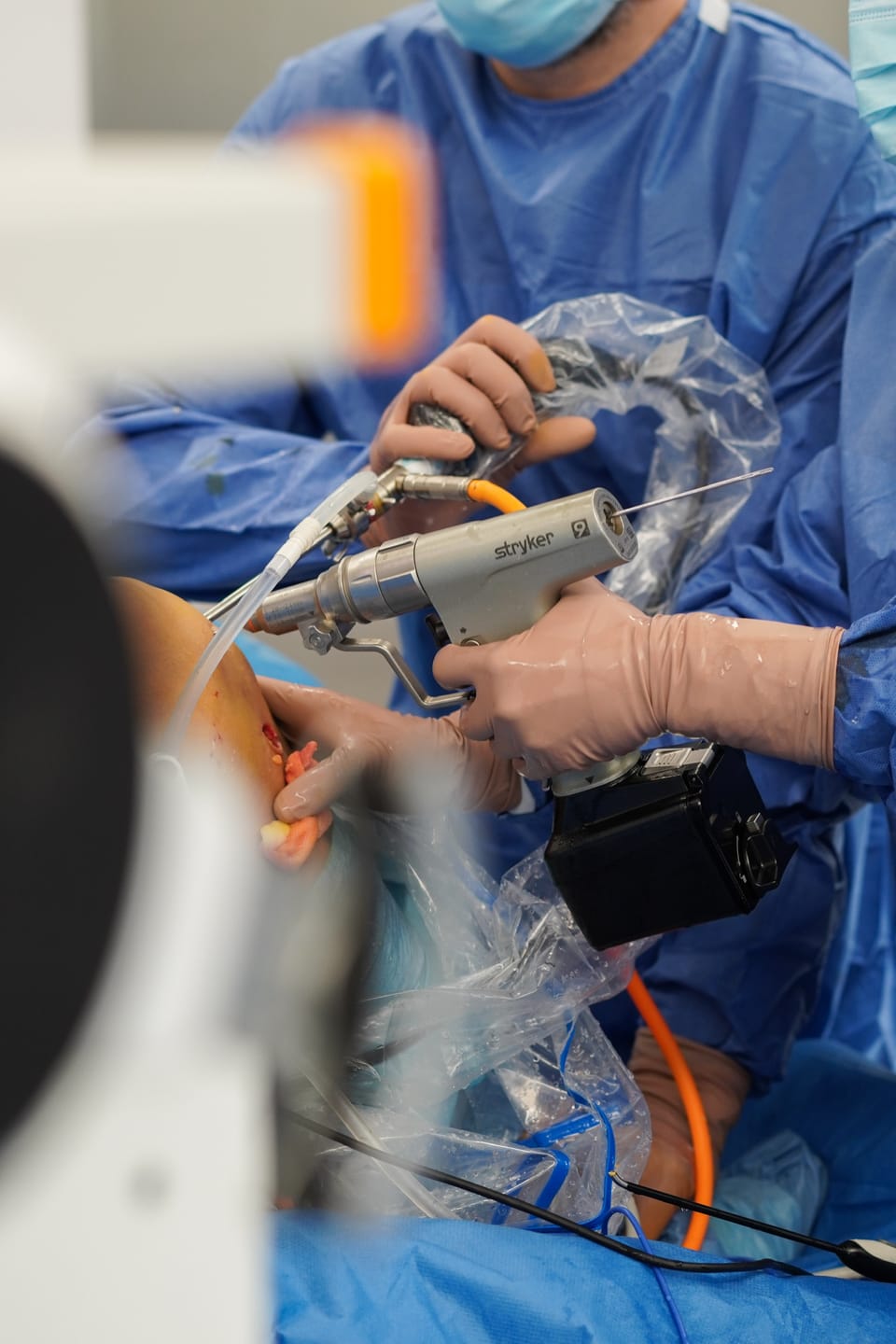
Surgeons using powered instruments during knee surgery

Knee conditions we treat

Every treatment plan starts with a diagnosis: your history, a careful examination and the right imaging, weighed against the activities you want to get back to.

ACL tears

If your knee gave way during sport, we assess how stable it is, whether the meniscus or other ligaments are also injured and which sport you want to return to. Surgery is not automatic: in the Swedish KANON trial, young, active adults who started with structured rehabilitation and had a reconstruction only if needed did as well at five years as those reconstructed early.

Meniscal tears

A tear after a sports injury and a degenerative tear in a middle-aged knee are different problems. The 2016 ESSKA consensus defines a degenerative lesion as one that develops without significant trauma in someone over 35, and advises against arthroscopic partial meniscectomy as the first treatment. Tears after an injury are assessed individually, taking into account the tear, the rest of the knee and your goals.

Instability and cartilage injuries

A knee that keeps giving way, a kneecap that slips out of place or a localised cartilage injury needs a precise diagnosis before any treatment is chosen. We look at the cause, the condition of the rest of the joint and your level of activity, and explain each option together with its limits.

Knee osteoarthritis

NICE guidance on osteoarthritis (NG226) notes that it is diagnosed clinically and usually does not need imaging to confirm it, and that the core treatments are therapeutic exercise and, where appropriate, weight management, together with information and support. Injections and surgery are discussed when these measures are not enough.

Problems after a knee replacement

If you already have a knee replacement that remains painful or is not working as expected, the first step is to find out why. In a US series of 781 revision knee replacements published in 2014, loosening and infection were the most common reasons for failure, and infection was the leading cause of revision within two years of the first operation.

Treatment options, from rehabilitation to knee replacement

Not every knee problem needs an operation. Options are discussed with you according to the diagnosis, the evidence and what you want to be able to do.

Rehabilitation and exercise

For many knee problems, the first step is a structured exercise programme. NICE recommends therapeutic exercise tailored to each person with osteoarthritis and suggests considering supervised sessions. For degenerative meniscal tears, a Norwegian trial in 140 middle-aged adults found no clinically relevant difference at two years between 12 weeks of supervised exercise and arthroscopic surgery, and thigh strength had improved more with exercise at three months.

Injections

Injections can ease symptoms in some cases, but they do not replace exercise. NICE suggests considering corticosteroid injections when other medicines are ineffective or unsuitable, or to support exercise, and explains that relief lasts only 2 to 10 weeks; it recommends not offering hyaluronic acid. In the RESTORE trial, with 288 patients, platelet-rich plasma did not improve pain or cartilage volume more than a saline placebo at 12 months. Each option is described on our regenerative medicine page (in Spanish).

Knee arthroscopy

In the Finnish FIDELITY trial, 146 patients aged 35 to 65 with a degenerative meniscal tear and no osteoarthritis did no better a year after arthroscopic partial meniscectomy than after sham surgery. NICE advises against arthroscopic washout or debridement for osteoarthritis, and the ESSKA consensus reserves it, in degenerative meniscal tears, for cases in which non-operative treatment has not worked. When it is proposed, we explain why, what it can achieve and the alternatives.

ACL reconstruction

Reconstruction can be done early or later, depending on how the knee responds to rehabilitation and on your goals. The graft can come from the patient's own quadriceps or hamstring tendons; in a comparative study of 52 patients co-authored by Dr Pomenta, both gave similar clinical and functional results after at least two years. Return to sport is planned with criteria, not just a date: in the Delaware-Oslo cohort, returning at nine months or later and with more symmetrical quadriceps strength substantially reduced the reinjury rate.

Knee replacement and revision

NICE suggests considering joint replacement when pain, stiffness or loss of function substantially affect quality of life and non-surgical treatment has not worked or is unsuitable, and advises against ruling people out because of age, sex, smoking, other illnesses or body weight. In a Danish trial of 100 patients, knee replacement followed by non-surgical treatment gave more pain relief and better function at 12 months than non-surgical treatment alone, but with more serious adverse events. Revision of a failing knee replacement is also part of the unit's work.

The knee unit and its surgeons

The unit is coordinated by Dr M. Victoria Pomenta, an orthopaedic surgeon who focuses on knee surgery: arthroscopy, sports injuries of the ligaments, menisci and cartilage, and knee replacement. She trained in orthopaedic surgery and traumatology at Hospital Clínic de Barcelona, completed an arthroscopy fellowship at the University of Barcelona and has published research on ACL reconstruction. She also sees patients in Joint Clinic's shoulder unit.

Dr Marc Ferrer Banús has a particular interest in knee conditions, especially degenerative and reconstructive joint surgery, including knee replacement and revision. He works at Hospital Clínic de Barcelona and, since April 2026, at Hospital Universitari El Pilar, and has co-authored research on revision knee replacement.

Dr Sergio Giles Fernández treats joint injuries and carries out reconstructive procedures and joint replacement surgery. He works at Hospital Clínic de Barcelona and, since April 2026, at Hospital Universitari El Pilar. Dr Patricia Pérez, also an orthopaedic surgeon and traumatologist, takes part in the assessment, treatment and follow-up of patients in the knee unit.

Arranging a visit from abroad

If you live outside Spain or have recently moved to Barcelona, our scheduling team can help you plan a first visit. The international patients page explains the general process.

To get in touch, call or send a WhatsApp message to +34 686 563 707, or email programacion@jointclinic.es. Let us know when you expect to be in Barcelona and which language you would prefer for the consultation.

For the consultation, bring any previous reports, your scan images (not just the written report) and, if you have had knee surgery before, the operation notes and implant details. A list of your medicines and allergies is also useful.

If surgery is recommended, the hospital, dates, preparation and follow-up are confirmed separately, after the consultation.

LocationAddressWhat happens there
Hospital El Pilar – QuirónsaludCarrer de Balmes 271, 08006 BarcelonaSpecialist consultations
Medical Tuset Barcelona (MTB)Carrer de Tuset 23-25, entresuelo, 08006 BarcelonaAssessment and follow-up for private patients and Asistencia Sanitaria members; no operating theatre

FAQ

Frequently asked questions

Can I be seen in English?

When you contact the scheduling team on +34 686 563 707 or at programacion@jointclinic.es, mention the language you would prefer for the consultation so the team can take it into account when arranging your visit.

How soon can I get an appointment?

Appointments are arranged through the scheduling team by phone or WhatsApp on +34 686 563 707, or by email at programacion@jointclinic.es. Telling the team the dates you will be in Barcelona helps them offer you a suitable appointment.

Is my health insurance accepted?

At the MTB Tuset clinic, the knee unit sees private patients and members of the Spanish insurer Asistencia Sanitaria. Before travelling, check with your insurer and with our scheduling team what your policy covers, as cover for consultations, scans and surgery may differ.

Do I need surgery for a torn ACL?

Not necessarily. In the KANON trial, 121 young, active adults with an acute ACL tear were treated with structured rehabilitation plus either early reconstruction or the option of a later one. At two and five years the results were similar, and about half of those offered the later option never had a reconstruction. The decision depends on your examination and your goals.

Am I too old or too heavy for a knee replacement?

Not automatically. NICE guidance on osteoarthritis advises against excluding people from referral for joint replacement because of age, sex, smoking, other illnesses or body weight, and recommends using a clinical assessment rather than a numerical score. It also notes that the risks of surgery vary with these factors, so they are discussed openly before any decision is made.

How long should I stay in Barcelona after knee surgery?

It depends on the operation and on how your recovery goes, so the team gives you a plan after the consultation. Book flexible travel if you can, and keep your reports and implant details with you when you fly home.

Contact

Contact Joint Clinic

Send us your reports and recent imaging. Please share only the information needed to assess your case.

Sources

  1. Frobell RB, et al. A randomized trial of treatment for acute anterior cruciate ligament tears. N Engl J Med. 2010 PMID 20660401.
  2. Frobell RB, et al. Treatment for acute anterior cruciate ligament tear: five year outcome of randomised trial. BMJ. 2013 PMID 23349407.
  3. Beaufils P, et al. Surgical management of degenerative meniscus lesions: the 2016 ESSKA meniscus consensus. Knee Surg Sports Traumatol Arthrosc. 2017 PMID 28210788.
  4. Sihvonen R, et al. Arthroscopic partial meniscectomy versus sham surgery for a degenerative meniscal tear (FIDELITY). N Engl J Med. 2013 PMID 24369076.
  5. Kise NJ, et al. Exercise therapy versus arthroscopic partial meniscectomy for degenerative meniscal tear in middle aged patients: randomised controlled trial with two year follow-up. BMJ. 2016 PMID 27440192.
  6. NICE. Osteoarthritis in over 16s: diagnosis and management (NG226). Recommendations. 2022
  7. Bennell KL, et al. Effect of intra-articular platelet-rich plasma vs placebo injection on pain and medial tibial cartilage volume in patients with knee osteoarthritis: the RESTORE randomized clinical trial. JAMA. 2021 PMID 34812863.
  8. Pomenta Bastidas MV, et al. Quadriceps tendon vs hamstring autograft in primary ACL reconstruction: a comparative study with minimum two-year follow-up. Acta Orthop Belg. 2022 PMID 36001842.
  9. Grindem H, et al. Simple decision rules can reduce reinjury risk by 84% after ACL reconstruction: the Delaware-Oslo ACL cohort study. Br J Sports Med. 2016 PMID 27162233.
  10. Skou ST, et al. A randomized, controlled trial of total knee replacement. N Engl J Med. 2015 PMID 26488691.
  11. Sharkey PF, et al. Why are total knee arthroplasties failing today: has anything changed after 10 years? J Arthroplasty. 2014 PMID 25007726.

Educational information: it does not replace an individual medical assessment.